






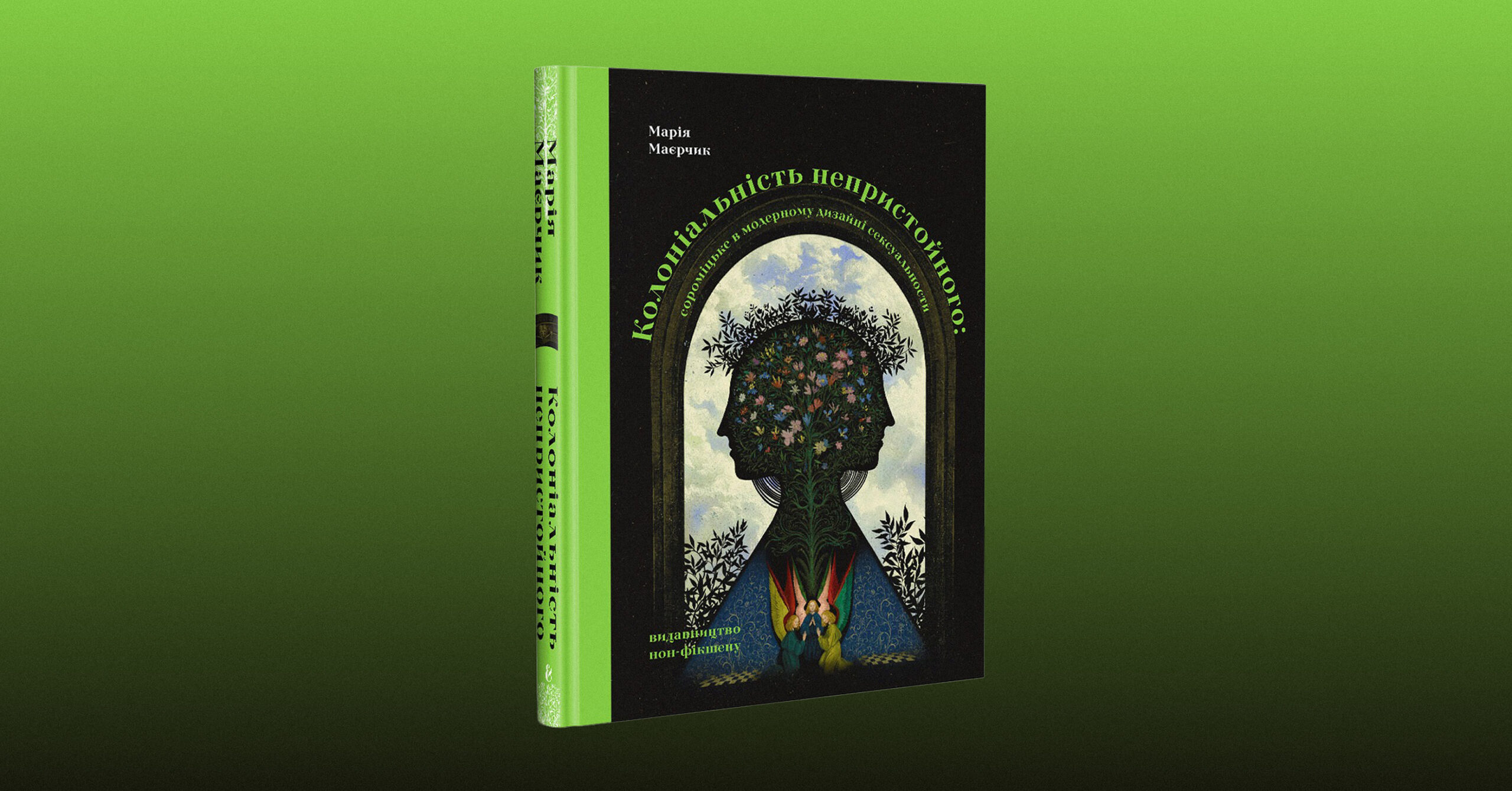
The publishing house Vydavnytstvo has released a study by Ukrainian social anthropologist and cultural historian Maria Mayerchyk titled ‘Coloniality of the Indecent: Erotic Folklore in the Modern Design of Sexuality’.
The book focuses on how perceptions of the obscene in Ukrainian society have changed from the Kyivan Rus period to the 20th century. It explores how the theocentric Ukrainian society of the 17th and 18th centuries could freely sing songs that the secular society of the 19th and 20th centuries came to label as immoral and ultimately banned, and examines how Ukrainian culture responded to these transformations.
According to the researcher, she wanted to release a book for a broad audience that ‘is thought-provoking and provocative, because it does not always follow the already familiar, established lines of knowledge about Ukrainian culture, yet at the same time it is deeply rooted in Ukrainian culture, grows out of it, and addresses a broader range of questions concerning global processes’.
Maria tells DTF Magazine more about her latest research
About the book
The book examines why things that were not considered obscene in premodern times came to be seen as such in the modern era. Why did modernity require new modes of obscenity? Why did obscenity maintain a single configuration throughout the Middle Ages and the early modern period — a span of over a thousand years — only for the transition to modernity to bring about the need for a new configuration?
The study shows that modern obscenity is linked to the main classificatory systems — race, ethnicity, gender, and sexuality — which also emerged in the 18th and 19th centuries and are closely connected with modernity. In other words, a new form of obscenity was needed because it played a role in constructing these systems, which we still rely on today.
This work also addresses ‘traditional values’ — a concept frequently invoked by conservative movements across Europe and beyond to justify their policies on family and gender. In Ukraine, some also appeal to these values to argue for the need for conservative reforms. My book demonstrates that these so-called ‘traditional values’ are, in fact, an invention of 19th-century coloniality. They have nothing truly traditional about them, except the tradition of imperialism and colonialism.
‘Coloniality of the Indecent’ examines those elements of traditional culture that were filtered out during the formation of cultural heritage. Cultural heritage is not just ‘what once existed’. It is material from the past — elements of culture that we select in order to construct our own idea of the past, one that serves our present-day needs and challenges.
When our cultural heritage was being formed in the nineteenth century, some elements of earlier culture were removed because they had come to be considered indecent. I wanted to see whether we could better understand the present by examining what was rejected — those elements that did not fit the image of our own past.
My book is also about obscene folklore, the history of intimacy, and the history of gender — and, above all, about tradition and modernity and their close, intimate connection.
Finally, the book poses a crucial question: if obscenity is tied to coloniality, and the discarding of traditions is linked to global colonial discourses, was there resistance to these processes within Ukrainian culture? Drawing on ethnography and folklore studies, I explore this question in the book.
How to colonize obscenity
Our bodies contain a certain kind of energy — a drive, a spectrum of emotions — that becomes the object of politics. When I say politics, I do not mean legislation, but rather social ideas or discourses that regulate this sphere of life. In the nineteenth century, this type of energy came to be called sexuality (this energy likely existed earlier as well, but it had different names and was regulated differently).
In fact, the word ‘sexuality’ appeared slightly earlier than the nineteenth century, but it was not originally associated with human intimacy — it came from the work of the botanist Carl Linnaeus. Thus, in the eighteenth century, only plants were considered to have a ‘sexual life’. The word entered the Ukrainian language only at the beginning of the twentieth century, initially appearing as ‘sexualism’.
It is remarkable that when ‘sexualism’ first entered Ukrainian dictionaries, it carried a dual meaning. One definition referred to Linnaeus’s system, which classified plants according to the structure of their flowers, pistils, and stamens. By the 1920s and 1930s, however, the concept of ‘sexuality’ in the Ukrainian language had acquired the meaning we use today.
The emergence of this new term was also driven by new ideas about intimacy and relationships, which are always regulated by particular discourses and norms. Local cultures around the world have always had their own understandings of intimacy and their own norms, but the modern idea of sexuality gradually displaced other systems of knowledge and meaning. Today, we effectively rely on a single concept of sexuality that emerged in Europe in the eighteenth and nineteenth centuries.
Sexuality as a concept is a product of modernity. Contemporary researchers suggest it is deeply intertwined with the rise of modern racism and gender ideologies — both of which are rooted in the colonialism that followed the expeditions of Marco Polo and Columbus, marking the beginning of the exploitation of overseas territories, populations, and resources.
It is important to distinguish between colonialism and coloniality. While colonialism in its historical form has largely ceased to exist, coloniality is a form of power produced by colonialism that has outlived it, persisting in our time and continuing to shape the modern world.
Sexuality (alongside economics and systems of knowledge, or epistemologies) is one of the domains of these colonial powers. And sexuality, as we know, is inseparable from the idea of the obscene. In other words, our understanding of the obscene is more sexualized than ever before in history. Therefore, yes — the obscene can be an instrument of coloniality.
When discussing sexuality, we aren’t talking about physical closeness, intimacy, or the act of copulation. Instead, we are referring to modern forms of power that regulate and assign meaning to these practices, whether bodily or otherwise. These powers — also known as biopowers — reach into the most intimate areas of our lives and largely shape them.
On changes in perceptions of intimacy and the obscene
We tend to imagine Ukrainian society of earlier eras — say, the 16th and 17th centuries — as deeply devout on the one hand, yet seemingly sexually uninhibited on the other. After all, how else could one explain that people publicly sang obscene songs, and that unmarried girls let young men stay overnight?
Scholars have long recognized this paradox for years, but struggled to explain it. ‘Coloniality of the Indecent’ takes up this uncomfortable topic in order to explore how ethical systems were structured when both of these phenomena coexisted without contradiction within the same society.
I also challenge the idea that this paradox can be explained by claiming that people in the past were somehow less ‘civilized’ or lacked proper moral principles. Of course, this is not true. To study history means being able to understand the systems of knowledge, ideas, and values (or ethical systems) of the past as they were understood by the people who lived within that culture.
Their culture was as logical and self-evident to them as ours is to us. For example, we don’t need an explanation to understand why 19th-century ethnographers removed so-called obscene songs from Ukrainian cultural heritage. We know they did this in order to erase signs of coarseness and ‘uncivilized’ behavior from the culture — to rid it of obscene and unnecessary ballast.
And yet, a hundred years from now, it may seem highly paradoxical that scholars were concerned with humorous obscene songs collected from peasants at the very same time that the peasantry was becoming the object of mass recruitment and the purchase of girls for prostitution in the territories of Asia and Latin America colonized by imperial states.
Is this not the real horror — the true sign of crudeness — as opposed to songs that were never a problem to begin with? Why did the songs come to seem like the greater problem (and were successfully removed), while international human trafficking developed and continues to thrive even today?
From the perspective of the future, the principles that regulate our ideas of intimacy and obscenity may also appear paradoxical — unless they are understood within a broader context, from colonialism to the emergence of nation-states.
Such contradictions, at the very least, highlight the shifts that have taken place in the sphere of intimacy and in ideas of the obscene over the course of several centuries. If what is unacceptable to us today was once the norm for the theocentric societies of the early modern period, this means that sexuality and obscenity have a history. They are not fixed or unchanging phenomena. Without revealing more of the book’s argument, I invite readers to explore it further and discover how sexuality and the obscene are woven into broader social and political processes, both global and local.
The book ‘Coloniality of the Indecent: Erotic Folklore in the Modern Design of Sexuality’ can be ordered on the website of Vydavnytstvo.