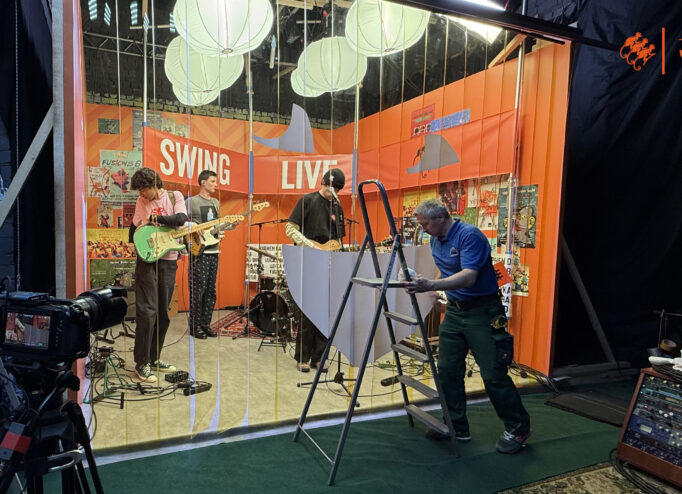






‘We wanted to show the maximum diversity of our community’, Myshko Birchenko said at the beginning of the Swing Live project, launched in May 2025 by FUSION JAMS and Monkey Shoulder. 19.99 represents alternative music, Figurat — soul, Bitlo — acid jazz, Hyphen Dash — fusion, ShchukaRyba — folk jazz, and Lucas Bird — indie music.
Now that the first season has come to an end and a vinyl compilation is being released, we’re giving the Swing Live participants the opportunity to share their own stories, talk about their creative practice, sources of inspiration, and the tracks they performed for the project.

ShchukaRyba
Yaryna Sizyk, Marharyta Kozynska, Halyna Honcharenko, Sofiia Andriushchenko, Denys Ivaniv, Stepan Andriushchenko, Dmytro Kokoshko, Yuliana Debopre — vocals; Yaroslаv Tatarchenko — keyboards/guitar; Oleksii Pavlenko — trumpet; Toni Stenko — saxophone; Oleksandr Yavdyk — drums.
— How did your collective come together? When did you realize you wanted to perform together, and what was the turning point that pushed you toward it?
— Stepan Andriushchenko: ShchukaRyba was formed seven years ago. At first, it was a group of people from the same community who had professional experience working with folk materials, performing in various projects, and who truly loved what they did. For us, traditional music and singing are, above all, a way of life — a way to celebrate and spend time with friends. At the beginning, we only sang, but later we formed an instrumental lineup and met sound producer Yaroslаv Tatarchenko. That’s what marked the start of our joint project — a combination of contemporary experimental music and traditional singing.
Our journey has been very organic, meeting wonderful people along the way who share our love for traditional culture. We all work toward the same goal: to share this beauty with the world.
— How would you describe your music to those who haven’t heard it yet?
— Careful preservation and minimal intervention in the original sound of the songs sung by Ukrainians a century or more ago. We provide an instrumental frame that complements the song, offering a fresh perspective while interacting with its traditional foundation.
— What has influenced your sound?
First and foremost, we are inspired by traditional singing. We work with it both as researchers and as performers. We study recordings made by ethnologists and folklorists in different parts of Ukraine, from the late 20th century to the present day. Ukrainian polyphony is what sets us apart and shapes our sound. And, of course, there are the feelings and the music written by Yaroslаv together with our wonderful musicians.
— Which of your tracks do you consider defining, and why?
— For each member of the project, it would be something different. Overall, we are probably best known for the track ‘Oi bula, bula v batechka dochka’, although it sounds quite different from the genres we work in now. But it was an essential stage that led us to the music that resonates with us most deeply today.
For me personally, the defining tracks are ‘Korabel’ and ‘Shche ne vmerla’ from our latest album. The first one is musically beautiful and emotionally powerful. And ‘Shche ne vmerla’ is a particularly significant song for us in general. It’s not the national anthem, but a piece recorded by folklorists in the 1990s from Kuban Ukrainians. They were resettled there back in the 18th century, yet over all that time they preserved their identity and a very archaic singing tradition.
— Tell us about the tracks you performed as part of Swing Live. Why did you choose them?
— ‘Korabel’ is a lyrical song from the village of Kliushnykivka in the Poltava region, recorded in 1990 by Dmytro Lebedynskyi. It is about the sea, about the elements. Melodically, it is an incredibly interesting and epic piece — one of our strongest and perhaps our most emotional tracks.
And ‘Vstala dievochka’ is probably the most high-energy one. It’s a carol from the village of Kyrdany in the Zhytomyr region, recorded by our friend — folklorist and volunteer Valerii Hladunets. The language is quite fascinating because it comes from Polissia — the borderland between Ukraine and Belarus. People there speak a dialect that differs significantly from the literary language. The carol is addressed to a girl: it was sung in homes where there was an unmarried daughter.
19.99
Dmytro Temnyi — guitar/vocals; Arsen Horbach — guitar; Ivan Marun — bass; Mykyta Kovtunenko — drums.
— How did your collective come together? When did you realize you wanted to perform together, and what was the turning point that pushed you toward it?
— Dmytro: Our band was born within the walls of the Glière Academy. At first, we played jazz, but we grew up on rock music. So after graduating from university, we had no desire to keep playing swing.
— How would you describe your music to those who haven’t heard it yet?
— Melancholic alternative rock with elements of punk.
— What has influenced your sound?
— The sound of the EP ‘Myne’ was specifically influenced by Radiohead, King Krule, and Nirvana.
— Which of your tracks do you consider defining, and why?
— My favorite tracks right now are the ones we’re currently working on. Unfortunately, they haven’t been released yet, and it’s still unclear when exactly they will come out.
Among the tracks already available on streaming platforms, I’d highlight ‘Liudy’ (People). I like its emotional and harmonic depth, as well as the unconventional choices we made during the recording process — and Arsen Horbach’s incredible guitar solo.
— Tell us about the tracks you performed as part of Swing Live. Why did you choose them?
— We performed two new compositions: ‘Nebo’ and ‘Dorohamy’. We chose them because they’re our newest material. We don’t want to keep repeating the same old set, so we decided to present something fresh.
Hyphen Dash
Myshko Birchenko — drums; Yevhen Puhachov — guitar; Polina Maiboroda — keyboards.
— How did your collective come together? When did you realize you wanted to perform together, and what was the turning point that pushed you toward it?
— Yevhen Puhachov: We once played together with Myshko and Lucas [Lucas Bird] at one of the first FUSION jams. Then we got together for a rehearsal, and I was looking forward to the next one so much that I couldn’t fall asleep.
— Polina Maiboroda: My first meeting with Myshko and Yevhen took place at Duma Studios, where we immediately recorded a full improvisational album. The guys were actually looking for a replacement for the band at the time, and I’m very grateful that they chose to trust me.
— How would you describe your music to those who haven’t heard it yet?
— Yevhen: This is music written without using any ‘references’. Depending on the listener’s previous experience, it can evoke all kinds of associations.
— Polina: It’s contemporary instrumental improvised music that blends jazz harmonies, experimental timbres, and the energy of rock music.
— What has influenced your sound?
— Yevhen: Everything.
— Which of your tracks do you consider defining, and why?
— Yevhen: All of them are significant in their own way, but I’d probably choose the track ‘Broken’. Sometimes I hear it on the streets of the city and I stop associating it with us — it’s as if it has just always existed. That’s how organic it feels to me.
— Polina: A defining one for me is ‘Berlin’. When we were playing it together at rehearsal while preparing for a solo concert, I thought about how happy I was and that I was exactly where I was meant to be.
— Tell us about the tracks you performed as part of Swing Live. Why did you choose them?
— Yevhen: ‘Matsuura’ is a very strange ‘construction’ that somehow works and keeps moving forward, even though it’s hard to explain how. ‘Birds Church’ is a bright and life-affirming song; you can clearly hear that it comes from a relatively peaceful, more naive time. ‘11:11’ is one of my favorites — very sincere and compositionally interesting. Listening to this track feels like watching a really great anime with a captivating plot and a moral to the story.
— Polina: To be honest, I don’t even remember why we chose those specific ones. ‘11:11’ has many different parts, yet they still come together harmoniously. I really love the ending, where Zhenia and I are left playing as a duo and have a kind of small musical dialogue. ‘Birds Church’ is the grooviest one — it constantly makes you want to nod your head to the beat. And ‘Matsuura’ is energetic and bold.
Figurat
Dmytro Alieksieienko — vocals; Nikita Dementiev — drums; Ihor Haponenko — keyboards.
— How did your collective come together? When did you realize you wanted to perform together, and what was the turning point that pushed you toward it?
— Dmytro: We’re from the south and have been together for many years. The guys have always liked what I do. I got tired of performing to backing tracks, so I asked them to play my music live. We’re not just a band — first and foremost, we’re friends, and each of us has our own solo projects.
— How would you describe your music to those who haven’t heard it yet?
— To be honest, I hate this question! Why should I have to explain anything to anyone? I’m not trying to convince anyone or impose my subjective view of creativity. Let people find it, listen to it, and describe it for themselves.
— What has influenced your sound?
— Absolutely everything: food, sleep, war, music, the city, films, therapy, and so on.
— Which of your tracks do you consider defining, and why?
— Behind each track, there’s a story — events I needed to work through. I find it hard to express my feelings directly, so I do it through my creativity.
— Tell us about the tracks you performed as part of Swing Live. Why did you choose them?
— I love FUSION, but I still don’t understand why they invited us. We’re pretty rough around the edges! (Laughs.)
When Myshko Birchenko wrote to me, I started picking out songs I could perform. The tracks ‘Vybach’ and ‘My’ turned out to be the closest match in terms of harmony and vibe.
Lucas Bird
Daniil Zubkov — Lucas Bird; Viktoriia Podroiko — bass; Myshko Birchenko — drums.
— How did your collective come together? When did you realize you wanted to perform together, and what was the turning point that pushed you toward it?
— The project came together in 2018, when my previous band broke up and I had accumulated enough material with a new, cohesive vision.
— How would you describe your music to those who haven’t heard it yet?
— A kaleidoscope of unconventional musical decisions, non-conformity, and a drive to deconstruct the canon.
— What has influenced your sound?
— Other music — like The Beatles, The Beach Boys, Todd Rundgren, and Beck — as well as my own search for interesting timbres as an audio engineer.
— Which of your tracks do you consider defining, and why?
— ‘Trashy’. For me, it’s the quintessence of my love for odd time signatures, broken beats, unexpected harmonies, quirky timbres, and melodicism.
— Tell us about the tracks you performed as part of Swing Live. Why did you choose them?
— We performed ‘Trashy’ and ‘Superstar’ because they’re our favorites from the new album. They’re fun to play, and we want more people to hear them.
BITLO
Mykola Zinchenko — guitar; Borys Mohylevskyi — EWI (electronic wind instrument); Oleksandr Malyshev — keyboards; Roman Humeniuk — drums.
— How did your collective come together? When did you realize you wanted to perform together, and what was the turning point that pushed you toward it?
The band came together out of an inner need to keep moving forward and explore new musical forms. We wanted to bring our shared love for hip-hop to life, to combine electronic sound with jazz improvisation. We wanted to play contemporary music that’s open to experimentation, where each member adds something of their own. That desire is what united the musicians — for whom improvisation is not just a technique, but a way of thinking.
The turning point came when we realized that we could create music directly during performances — on the fly — relying on ensemble interaction, a shared jazz background, experience, and deep listening to one another. Many compositions were born as improvisational sketches: over time they took shape, were transcribed into sheet music thanks to Mykola, and were reimagined and transformed, yet they always preserved the raw energy of the initial impulse. It was this very process — from spontaneity to a more conscious structure — that defined our desire to perform together and grow as a collective.
— How would you describe your music to those who haven’t heard it yet?
— BITLO is improvisational, beat-oriented contemporary music with roots in traditional jazz, hip-hop, fusion, and the soundtracks of video games and anime. It’s all created by professional musicians and made with love.
— What has influenced your sound?
— The way our band came together had a massive influence on us. We played a lot of gigs in bars where we could really let loose and do whatever we wanted musically. But since it was meant to be a quartet, we couldn’t afford a bass player. So we started looking for ways to fill the space with a synthetic bass, a ‘one-handed’ keyboardist, and guitar. Then Mykola Zinchenko, our guitarist, fell deeply in love with drum machines and samplers. Over time, his collection of gear grew, and our sound started to evolve into something really interesting. And somewhere along the way, Borys Mohylevskyi bought an EWI — and that’s when it all really came together.
— Which of your tracks do you consider defining, and why?
— I’d say it’s ‘Animeboy’. It’s been waiting to be released for a few years now, with vocals already recorded, but we just haven’t managed to put it out yet. We actually have a lot of great material that hardly anyone has heard, and I hope it will all reach a wider audience someday.
— Tell us about the tracks you performed as part of Swing Live. Why did you choose them?
— We performed ‘Salvador’ and ‘S U P R E M E P I Z Z A’. As the author admitted, he doesn’t really know what ‘Salvador’ is about, but it has a very catchy melody that’s easy to remember and hum along to. The track is also quite energetic — you can even dance to it a little. As for ‘Pizza’, it got its name because it’s made of many different parts, yet everything is so well-composed that it sounds ‘delicious’. We’re really proud of that track.
This material was created with the support of